
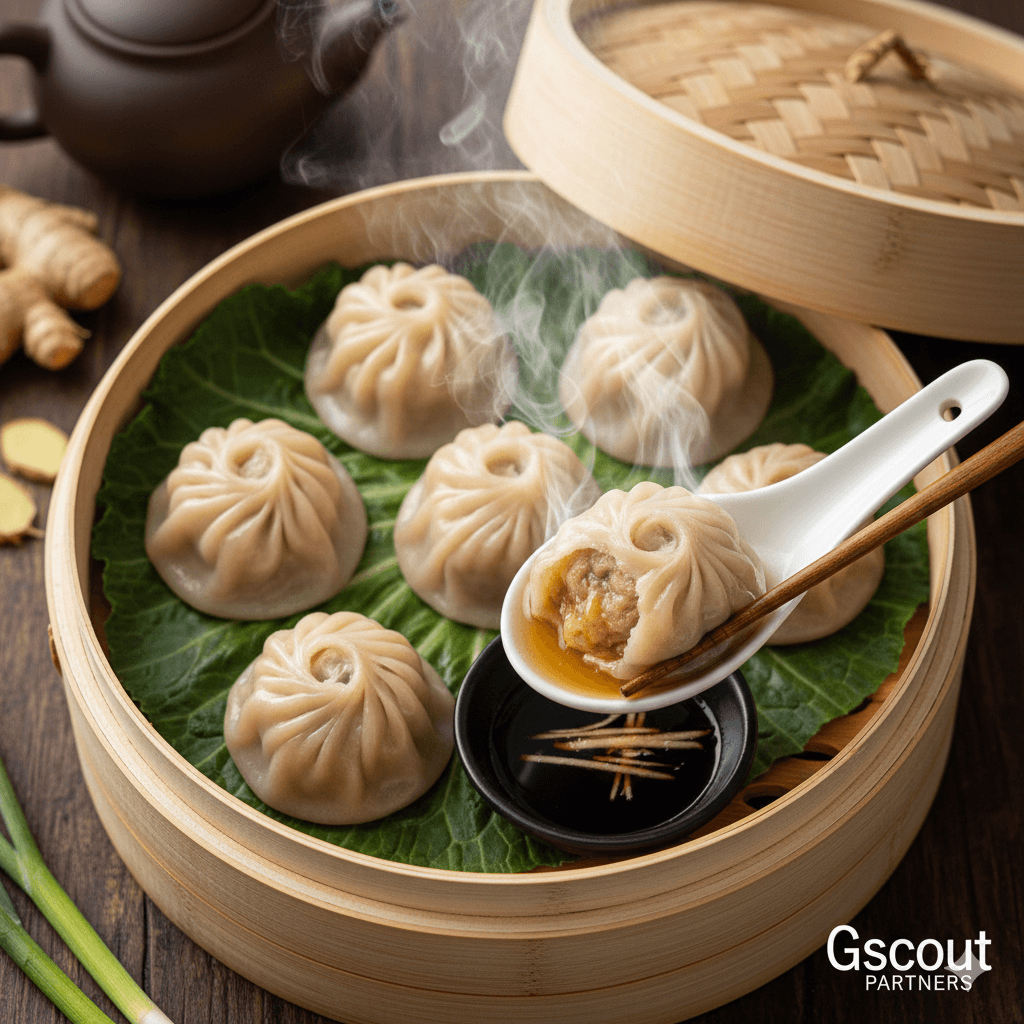
The Art of the Fold: A Deep Dive into the Soul of Shanghai’s Xiaolongbao
Welcome back! As Gscout Partners, we are diving deep today into a culinary icon that is as much a feat of engineering as it is a masterpiece of flavor. We’re talking about Xiaolongbao (小笼包)—the delicate, soup-filled wonders that have traveled from the steaming bamboo baskets of the Jiangnan region to the global stage.
In this guide, we’ll explore the history, the chemistry of the “magic soup,” the rigorous technique required to craft them, and how to eat them without losing a single drop of that precious broth.
1. The Origin Story: From Nanxiang to the World
While many associate Xiaolongbao exclusively with Shanghai, their true ancestral home is Nanxiang, a canal town on the outskirts of the city.
The Legend of Huang Mingxian
In the late 19th century (around 1875), a pastry chef named Huang Mingxian decided to innovate on the traditional steamed bun. He wanted to create something so unique that it would stand out in a crowded market. He hit upon two revolutionary ideas:
-
Miniaturization: Making the buns smaller and more delicate.
-
The Liquid Surprise: Developing a way to trap savory soup inside a sealed dough wrapper.
Originally called Nanxiang dayourou mantou (Nanxiang large meat-filled bun), the name eventually evolved into Xiaolongbao, which literally translates to “little basket bun,” referring to the small bamboo steaming crates (xiaolong) they are cooked in.
2. Anatomy of a Masterpiece
What makes a Xiaolongbao “perfect”? It is a delicate balance of three core components: the Skin, the Filling, and the Soup.
The Delicate Skin (The Wrapper)
Unlike the fluffy, bread-like texture of a Baozi, the skin of a Xiaolongbao is unleavened. It must be:
-
Paper-thin: Translucent enough to see the shadow of the meat and broth inside.
-
Strong: Elastic enough to hold the weight of the soup without bursting when lifted with chopsticks.
-
The Golden Ratio: Master chefs aim for exactly 18 pleats or more to seal the top. This isn’t just for aesthetics; the pleating creates a reinforced “knot” at the top to act as a handle.
The Savory Filling
The traditional filling is seasoned ground pork. However, modern variations often include:
-
Pork and Crab Roe: A Shanghai delicacy where the richness of crab fat cuts through the savory pork.
-
Truffle or Shrimp: Modern gourmet twists found in high-end dim sum houses.
The Magic: How does the soup get inside?
This is the most common question for first-time eaters. You don’t “inject” the soup. Instead, chefs use Aspic (meat gelatin).
-
A rich broth is made by simmering pork skin, ginger, and scallions for hours until the collagen breaks down.
-
The broth is chilled until it sets into a firm jelly.
-
The jelly is minced and folded into the raw meat filling.
-
The Science: When the bun is steamed, the heat melts the gelatin back into a liquid, creating a hot pool of soup trapped inside the cooked dough.
3. The Ritual: How to Eat Xiaolongbao
Eating a Xiaolongbao is an art form. If you simply bite into it, you risk two things: scalding your mouth or drenching your shirt in fatty broth. Follow this sequence for the ultimate experience:
| Step | Action | The “Why” |
| 1. The Dip | Gently lift the bun by the “knot” and dip the base into a sauce of Chinkiang vinegar and julienned ginger. | The acidity of the vinegar balances the richness of the pork. |
| 2. The Cradle | Place the bun onto your deep Chinese soup spoon. | This provides a safety net so the bun doesn’t break. |
| 3. The Vent | Bite a tiny hole in the side of the wrapper. | This allows the steam to escape so you don’t burn your tongue. |
| 4. The Sip | Slowly slurp the broth out of the hole. | This lets you savor the pure flavor of the soup first. |
| 5. The Finish | Consume the rest of the bun and the ginger. | A perfect, harmonious final bite. |
4. Crafting the Perfect Batch: A Technical Breakdown
For those looking to recreate this at home, precision is key. As we often discuss at Top10doc, having a clear “blueprint” is essential for complex tasks.
The Aspic (The Soup Base)
To get a high-quality gelatin, you need parts rich in collagen.
-
Ingredients: 500g pork skin, 1 bunch scallions, 50g ginger, 2 tbsp Shaoxing wine.
-
Process: Simmer for 2 hours, strain, and chill for 6+ hours.
The Dough
The dough is a simple mix of flour and water, but the kneading is where the magic happens.
-
Formula: 200g All-purpose flour + 100ml warm water (approx. $50^\circ C$).
-
Resting: You must let the dough rest for at least 30 minutes to relax the gluten, otherwise, it will snap back when you try to roll it paper-thin.
The Steaming
Timing is everything.
-
High Heat: Steam for exactly 8 minutes.
-
The Liner: Use cabbage leaves or parchment paper with holes to prevent sticking. If the skin tears on the bottom, the soup is lost!
5. Global Impact and the “Michelin” Standard
Xiaolongbao transitioned from a local street snack to a global phenomenon largely thanks to brands like Din Tai Fung. Originating in Taiwan, they standardized the “18-pleat” rule and brought a level of clinical precision to the craft that earned them Michelin stars.
Today, you can find Xiaolongbao in every major city, from New York to London. However, for the purist, nothing beats a steaming basket in a crowded Shanghai eatery, where the vinegar is dark, the ginger is fresh, and the history is palpable.
Conclusion
The Xiaolongbao is a testament to the ingenuity of Jiangnan cuisine. It represents a perfect marriage of physics and flavor—a delicate balloon of dough holding a world of savory warmth. Whether you are a seasoned foodie or a curious newcomer, every basket offers a new opportunity to appreciate the skill of the “Sifu” (Master) who folded it
Frequently Asked Questions (FAQ)
1. What is the meaning and English name for Xiaolongbao?
The name Xiaolongbao (小笼包) literally translates to “little basket bun.” In English-speaking regions, they are most commonly referred to as “Soup Dumplings.” While they are called “buns” (bao) in Chinese, their thin skins make them much more similar to what Westerners categorize as dumplings.
2. What is the “jelly stuff” inside the dumplings before they are cooked?
That “jelly stuff” is called aspic. It is a concentrated pork stock that has been cooled until the natural collagen turns it into a solid gelatin. This is the secret to the dish: the jelly stays solid while the chef folds the dumpling, but transforms into “soup drops” of liquid gold the moment it hits the heat of the steamer.
3. What makes Xiaolongbao unique compared to other dumplings?
Unlike standard potstickers or wontons, Xiaolongbao features a liquid center. While a typical dumpling is “wet” from meat juices, the Xiaolongbao is engineered to be a self-contained bowl of soup. Furthermore, its unleavened skin is much thinner and more elastic than the doughy, bread-like wrapper of a traditional Baozi.
4. Can I use premium meats like Iberico Pork?
Absolutely. Using Iberico pork is a massive trend in high-end dim sum. Because Iberico pork has a higher fat content and a nuttier flavor profile, it creates an even richer, more luxurious broth. If you’re looking to elevate your blog’s recipe, suggesting Iberico pork is a great way to appeal to gourmet readers.
5. Is Xiaolongbao healthy to eat?
Like most dim sum, Xiaolongbao is a treat. While it is steamed (not fried), the broth is high in sodium and collagen-rich fats. One dumpling typically contains about 40–60 calories. It’s perfectly fine as part of a balanced diet, but because they are so small and delicious, it is very easy to eat ten in one sitting!
6. Can I use “Dog Bone Broth” for the filling?
If you are making these for human consumption, it’s best to stick to culinary-grade pork or chicken stock. While Dog Bone Broth is a trending health supplement for pets (often made without onions or garlic), traditional Xiaolongbao relies heavily on aromatics like ginger, scallions, and Shaoxing wine, which are essential for that authentic Jiangnan flavor.
7. How does it compare to other “comfort” dishes like Tteokbokki or Lasagna Soup?
While Tteokbokki (Korean rice cakes) offers a chewy, spicy heat and Lasagna Soup provides a tomato-based, cheesy comfort, Xiaolongbao is prized for its “clean” savory profile and the “explosion” of broth. They all fall under the “comfort food” umbrella, but Xiaolongbao is the most technically difficult to master.
8. Can I cook these on a Portable Wood Grill?
Cooking Xiaolongbao requires consistent, wet steam. While you could place a bamboo steamer on a portable wood grill, it is difficult to regulate the temperature. A traditional stove-top or a dedicated electric steamer is recommended to ensure the delicate skins don’t break or dry out from the dry heat of a grill.
9. What is the correct way to eat them?
Never pop the whole thing in your mouth immediately! Place the dumpling on a spoon, poke a small hole in the side to let the steam out, sip the soup, and then eat the remaining dumpling with a bit of ginger and vinegar.