
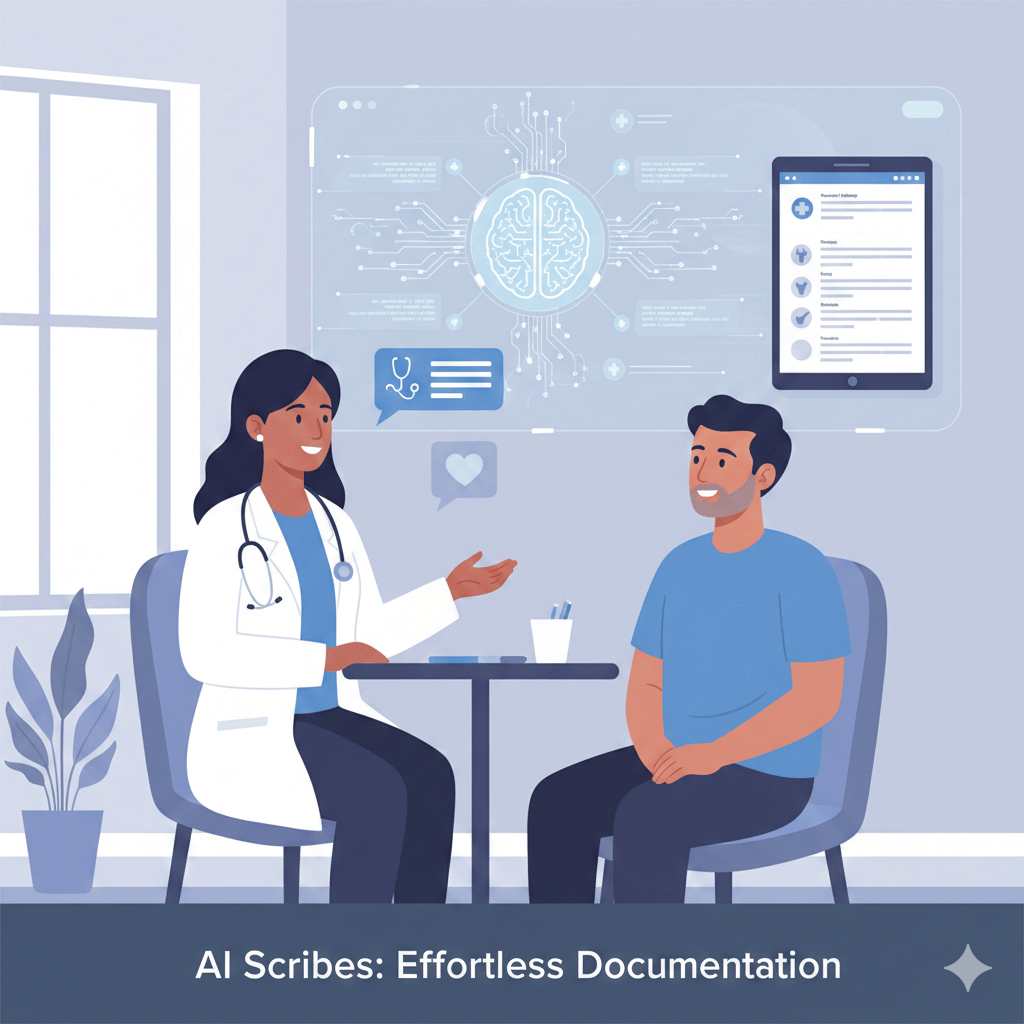
The Digital Stethoscope: Best AI Medical Scribe Software for Indian Doctors in 2026
In the bustling clinics of Mumbai, the crowded OPDs of Delhi, and the specialized centers of Bengaluru, a quiet revolution is happening. It isn’t a new drug or a surgical robot; it’s the AI Medical Scribe.
As we navigate 2026, the “pajama time” spent by Indian doctors on documentation is finally being reclaimed. With patient volumes in India often exceeding 50–100 consultations per day, the administrative burden has historically been the primary driver of physician burnout. Today, AI has stepped in to bridge the gap between quality care and efficient documentation.
The Burden of the Pen: Why India Needed a Digital Shift
For decades, Indian doctors have faced a unique set of challenges:
-
Extreme Patient Volume: Unlike Western counterparts who see 15–20 patients, Indian GPs often handle quadruple that amount.
-
The “Hinglish” Factor: Clinical conversations in India are rarely monolingual. They are a rich tapestry of English, Hindi, and regional dialects.
-
Administrative Bottlenecks: Manual note-taking slows down the patient flow, leading to longer wait times and shorter face-to-face interaction.
AI Medical Scribes are ambient listening tools that securely capture these conversations and transform them into structured, EHR-ready clinical notes.
Top 5 AI Medical Scribes for Indian Doctors: 2026 Comparison
To help you choose the right partner for your practice, we’ve analyzed the top players based on accuracy, linguistic flexibility, and cost-effectiveness.
| Feature | Thunai AI | Sunoh.ai | HealthOrbit AI | Heidi Health | Freed AI |
| Best For | Indian Languages & Dialects | Established Clinics | Diagnostic Co-pilot | Budget & Startups | Solo Practitioners |
| Hinglish Support | ⭐⭐⭐⭐⭐ | ⭐⭐⭐ | ⭐⭐⭐ | ⭐⭐ | ⭐⭐⭐ |
| Key Value | Native Dialect Accuracy | Multi-speaker Capture | Revenue & ICD Coding | Free-Forever Tier | Speed & Simplicity |
| EHR Integration | High (Indian EHR focus) | High (Global focus) | Seamless | API-based | Browser Extension |
| Price (Approx.) | ₹6,500/mo ($79) | ₹12,500/mo ($149) | Custom / Tiered | Free to ₹8,000/mo | ₹7,500/mo ($90) |
| Checkout Link | Visit Thunai | Visit Sunoh | Visit HealthOrbit | Visit Heidi | Visit Freed |
1. Thunai AI: The Master of the Indian Dialect
Why it’s a Top Pick for 2026:
Thunai was built from the ground up to solve the “Language Problem.” Most global AI scribes struggle with the nuances of Indian accents and the tendency of patients to switch between languages (code-switching).
How it helps the Doctor:
-
Contextual Accuracy: It understands that “bukhaar” means fever and “dard” means pain, even when the rest of the sentence is in English.
-
Reduced Hallucinations: By using a specialized “Medical Knowledge Graph,” it ensures the AI doesn’t “invent” symptoms the patient didn’t mention.
Value Proposition: It saves an average of 3 hours per day for multi-specialty Indian doctors who treat diverse linguistic populations.
2. Sunoh.ai: The Reliable High-Volume Partner
Why it’s a Top Pick for 2026:
Sunoh.ai has become the gold standard for reliability. It is particularly adept at “Ambient Listening”—the ability to filter out background noise in a busy Indian clinic.
How it helps the Doctor:
-
Multi-Speaker Identification: It can distinguish between the doctor, the patient, and the patient’s relative (a common occurrence in Indian consultations).
-
Structured SOAP Notes: It produces exceptionally clean Subjective, Objective, Assessment, and Plan (SOAP) notes that require minimal editing.
Value Proposition: High reliability for busy OPDs where accuracy cannot be compromised by environmental noise.
3. HealthOrbit AI: The Intelligent Clinical Co-pilot
Why it’s a Top Pick for 2026:
HealthOrbit isn’t just a scribe; it’s an assistant. By 2026, it has integrated deep clinical reasoning that helps with more than just paperwork.
How it helps the Doctor:
-
Diagnostic Suggestions: While you talk, it can suggest potential ICD-10 codes or remind you to check for specific contraindications.
-
Revenue Optimization: By ensuring all billable services mentioned in the conversation are captured in the notes, it reduces revenue leakage.
Value Proposition: It transforms documentation from a chore into a revenue-generating asset.
4. Heidi Health: Accessibility for All
Why it’s a Top Pick for 2026:
For young doctors starting their own “Clinic 2.0,” Heidi Health is the most accessible entry point due to its generous free tier.
How it helps the Doctor:
-
Unlimited Transcription (Free): Doctors can start using AI immediately without any financial risk.
-
Community Templates: You can access thousands of note templates created by other specialists (Cardiologists, Dermatologists, etc.) globally.
Value Proposition: Removes the financial barrier to digital transformation for small practices.
5. Freed AI: The 30-Second Scribe
Why it’s a Top Pick for 2026:
Freed is designed for the doctor who hates technology. There are no complex menus—just a “Start” and “Stop” button.
How it helps the Doctor:
-
Instant Summaries: Notes are ready within 30 seconds of finishing the visit.
-
Style Learning: The more you use it, the more it learns your specific shorthand and “voice.”
Value Proposition: The fastest onboarding process; you can be up and running in under 2 minutes.
Data Privacy: The DISHA & ABDM Compliance
In 2026, data security in India is non-negotiable. All the suggestions above adhere to:
-
DISHA (Digital Information Security in Healthcare Act): Ensuring patient data remains within protected silos.
-
ABDM (Ayushman Bharat Digital Mission): Integration with ABHA IDs for a unified longitudinal health record.
-
Local Data Residency: Ensuring that sensitive health data is stored on Indian servers where required.
How AI Scribes Create “Value” Beyond the Note
-
Empathy-First Care: When the doctor isn’t typing, they are looking at the patient. This improves the “Healing Touch” that Indian patients value so highly.
-
Medico-Legal Safety: Detailed, timestamped AI notes provide a robust defense in the rare event of litigation.
-
Referral Efficiency: Generated summaries can be instantly WhatsApped or emailed to referring specialists, ensuring no information is lost in transit.
Conclusion: Reclaiming the Soul of Medicine
As we look at the landscape in 2026, AI Medical Scribes are no longer a luxury—they are a necessity for the modern Indian practitioner. Whether you choose the linguistic prowess of Thunai, the reliability of Sunoh, or the accessibility of Heidi, the goal remains the same: Focus on the patient, let the AI handle the pen
People Also Ask: AI in Healthcare 2026
What is the best AI scribe for doctors?
In 2026, SteerNotes and Heidi Health are frequently cited as top choices for general practices due to their high customization. For large hospital systems, Nuance DAX remains the industry leader for enterprise integration, while Thunai AI is widely considered the best for Indian doctors specifically because of its ability to handle “Hinglish” and regional accents.
Is AI replacing medical scribes?
AI is not replacing the function of medical scribes, but it is replacing the human-only model. In 2026, most “scribing” is done by AI, but human “Virtual Scribes” have shifted roles to become AI Quality Guardians. They now oversee the AI-generated drafts for complex cases, ensuring 100% accuracy while the AI handles the bulk of the manual transcription.
Which AI is best for medical doctors?
It depends on the task:
-
For Documentation: Nabla or Sunoh.ai.
-
For Diagnostics: Google’s Med-PaLM 2 or HealthOrbit AI.
-
For Research: Specialized versions of ChatGPT (GPT-5/6) or Perplexity Pro are best for scanning medical literature and summarizing clinical trials.
What is the future of medical scribes in India?
The future in India is a Hybrid Model. With the National Medical Commission (NMC) promoting digital literacy, Indian doctors are adopting AI tools like EkaScribe to handle high patient volumes. By 2030, manual note-taking will be nearly obsolete in urban Indian clinics, replaced by ambient AI integrated directly into ABDM-compliant EHRs.
Who are the “Big 4” of AI?
The companies currently leading the global AI landscape are:
-
OpenAI (Creators of ChatGPT)
-
Google DeepMind (Gemini and Med-PaLM)
-
Microsoft (Azure AI and Nuance)
-
Anthropic (Claude AI)
What software do medical scribes use?
Modern scribes use Ambient Intelligence platforms like Abridge, Suki, or Freed AI. These tools listen to the visit and automatically populate fields in major EHRs like Epic, Cerner, or Practo (in India).
Which 3 jobs will survive AI?
While many tasks will be automated, roles requiring High Empathy, Manual Dexterity, and Complex Ethical Judgment are safest:
-
Surgeons & Nurses: Hands-on care and complex physical procedures.
-
Psychiatrists/Therapists: Human emotional connection and nuance.
-
AI Ethics & Compliance Officers: Managing the legal and moral use of AI in medicine.
Can AI replace doctors in India?
No. The National Medical Commission (NMC) has stated that AI is a “complement, not a replacement.” While AI can analyze a scan faster than a human, the legal responsibility, ethical decision-making, and “healing touch” required in the Indian socio-cultural context remain uniquely human.
What jobs will AI replace by 2030?
Roles centered on repetitive data processing are most at risk:
-
Medical Transcriptionists
-
Basic Data Entry Clerks
-
Standardized Billing & Coding Specialists
-
Radiology Assistants (first-pass screening)
Which medical software is best?
For Indian practitioners in 2026, Eka Care and Halemind are top-rated for Practice Management. For Electronic Health Records (EHR) globally, Epic remains the gold standard, though it is primarily used in larger Indian corporate hospitals.
Is Scribe better than ChatGPT?
Yes, for clinical use. While ChatGPT is a general-purpose tool, an AI Scribe is HIPAA/DISHA compliant, understands specific medical terminology, and is designed to filter out “small talk” to create a professional SOAP note—something ChatGPT often fails to do without extensive prompting.
How much does Nabla AI scribe cost?
In 2026, Nabla Copilot pricing typically starts at $119 per month for individual providers with unlimited note generation. They also offer a limited free tier (roughly 20-30 notes/month) for doctors who want to test the technology before committing.